
Table of Contents
RS-928 HF amplifier review
Background
About a year ago I wanted an SDR transceiver and didn't really take to the user interfaces on any of the “black box” SDRs, so started to think about PC-based SDRs. The performance of a Flex or Anan would have been wasted for the odd rag chew on my backyard antenna system, I needed something Linux based and wanted something with a bit of potential for tinkering-with so I settled on a Hermes Lite 2.
Having played with it for a while, both barefoot on HF and driving a transverter on 2M, I longed for a bit more power than its' 5W on the HF bands so started looking around for an amplifier to get me up to 100W or so. I thought about utilising a PA stage from an old HF rig and writing some code for the HL2 IO board to do the band switching but there was a danger that this would join the back of my never ending project queue and a conversation on the HF bands brought a recommendation for this amplifier so I thought I'd give it a go.
The amplifier is touted as an “RS-928” on Alibaba, Ebay and AliExpress. I found a UK based Ebayer called electro.tek and purchased mine from him. It arrived well packged within a day or two so I was delighted with the service from him.
I will say from the outset that, despite this amplifier being marketed as a 150W amplifier, it should be regarded as a 100W unit, in my view. It might be possible to get 150W out of it on some bands, but it will be well into compression, and possibly stressing the output devices at that level. Better to drive it to 100W and keep the output clean!
The other thing worth saying from the outset, and something that I realised only after purchasing the unit: It's basically a clone of the Juma PA100-D. https://jumaradio.com/juma-pa100/. The Juma amp was previously available as a kit, and is currently available as a fully built unit from RoWaves: https://rowaves.com/juma-pa-100d-100w-hf-linear-pa/, albeit for a significantly less attractive price!
The Chinese manufacturer of this amplifier haven't simply lifted the Juma gerbers and firmware. There has been some rearrangement of the internal connectors and board layout, and customisation of the splash screen that appears at power-on, but the design is clearly a rip-off of the PA-100D, and I'm guessing it's not been done with the blessing of the original developers. I'll leave it to the individual reader's conscience as to whether it's right to purchase the RS-928 amplifier. My comments and experiences here would no doubt apply to the “official” Juma amplifier from their partners at RoWaves, so there is a route to purchase an officially sanctioned amplifier for those who would rather not buy the clone.
Whichever amplifier you go for, being previously available as a kit means that there is a full set of schematics, build instructions, setup procedures and even firmware source code on the Juma site. There's also a support forum and, whilst it would be wrong to ask for support there if you've purchased a clone amp, there is no doubt some useful experience with the PA-100D documented there.
Construction
Out of the box, the amplifier feels very sturdy, being housed in a rugged brushed aluminium enclosure with a smart screen printed front panel, a couple of grab handles on the front and a substantial rear panel with heatsink fins, all machined from what looks like solid ali. There's plenty of weight to the latter, making it able to absorb a decent amount of heat from the finals. A fan is fitted to the rear to assist it in this respect, but it's not intrusive in operation. More about cooling later.
The rear panel features SO239 sockets for RF input and output, a fairly substantial 2 pin connector for the 13.8V DC input and three 3.5mm jack sockets for a key signal input (which also features an output for daisy-chaining to other amplifiers), an RS-232 port, which can be used for CAT polling of the band from a transceiver or limited remote control and monitoring, and an analogue band input for Yaesu style band selection.
There are four substantial feet on the bottom panel and the user interface comprises a decent number of push buttons on the front panel, with status information on a 2-line alphanumeric LCD with blue backlight.
The unit was supplied with a substantial PL-259 patch cable and SO239-BNC adaptor, a double fused supply cable and various 3.5mm jack leads intended to hook up the keying and band selection signals to assorted rigs. There wasn't anything to fit the Hermes lite but I soon found a 3.5mm jack to RCA cable that did the job.
All in all, the construction feels well able to stand up to use in the shack and in mobile or portable use. I wouldn't want to lug it up to a SOTA site. I think a smaller amplifier would fit the bill better for that use case. (it's worth mentioning that the RS-928 is significantly larger than the original Juma device) I also haven't tried operating it on batteries. It has configurable voltages for over- and under-voltage alarms, so could potentially be powered from a wide range of input voltages if derated as required.
Operation
The amplifier has separate front panel buttons for powering up and down, selecting the band, selecting the operate / standby state, selecting automatic or manual band selection, adjusting the input attenuator, and selecting which parameter is moniored on the display, making manual operation simple. The aforementioned attenuator has 4 settings to adjust the sensitivity in approximately 2dB steps, allowing input powers from about 2.5W to 10W to be accommodated, or to reduce the output power at a given input power, for example, to use high duty cycle modes.
The display continuously displays the selected input attenuation, operate / standby state, manual or auto band selection, and selected band. A numerical indication can be cycled through a number of different parameters including supply voltage and current, heatsink temperature, output power and SWR. In addition, a bar graph indication can simultaneously display another parameter. The output power display over-reads significantly on my example, but there is a way to calibrate all of the measurements in a service menu.
Despite supporting several band data input methods, the amplifier senses the incoming frequency and will instantly switch to the appropriate band if manual or automatic methods have failed to select the correct band. This can occasionally result in a high current alarm if the amplifier hot switches or has tried to deliver significant power into a mismatched band, but if a small amount of power is applied after each band change, or transmit power is first applied with the amp in standby, the amplifier is perfectly usable by frequency sensing alone.
One irritation is that the high SWR alarm will trip in standby as well as operating state, and regardless of the power being delivered. This became a nuisance when changing bands and tuning an ATU on low power. I had to increase the SWR trip threshold to a very high value to avoid this, defeating the high SWR protection function.
Aside from this, the amplifier was easy to work with thanks to the simple control layout which avoids the need to enter menus when changing bands and power levels.
Performance
Despite touting itself as a 150W amplifier, it won't reach that power level key-down on all bands, and won't do so cleanly on any bands. It would have been more honestly described as a 100W amplifier, as Juma did, in fact.
As mentioned, the output power measurement was reading high on my amplifier and, in fact, the calibration constant for this had been set at its default level, so it was probably never calibrated during production. This can be easily adjusted if it's of concern. There is a setup procedure for the Juma amp which can be followed.
I checked the level of harmonics on a couple of bands and they were down to -60dBc or so. I made a crude intermod measurement using the Hermes Lite to generate a two-tone signal. The third order product was around -36dBpep at 100W output and the higher order products dropped away rapidly. It improved when driven below this power level and got rapidly worse above. The level of intermods from the driving signal from the HL2 were significant, so this isn't a great test of the amplifier in isolation, but it proves that the combination with the HL2 is reasonably clean at 100W output. It's as good if not better than the average Japanese black box.
The heatsink is very substantial and easily cools the amplifier in most use cases. Rag-chewing at 100W SSB barely heats the heatsink above ambient and a busy session of FT8 at about 60W sees it occasionally hit the 40C threshold at which the fan kicks in. The fan very quickly cools it down again in this instance (especially given that my loft shack is cold this time of year!). The fan isn't too intrusive and has several speeds so doesn't run at full speed until the amplifier gets significantly hotter. I felt that the case could do with some ventilation holes. It doesn't have any, but does contain some big resistors, the magnetics for the amplifier and filters, which could benefit from some cooling. That said, being sealed keeps the dust out and it doesn't appear to suffer from lack of cooling.
Given a supply of about 13.4V, current drain at 100W carrier output was about 16 Amps, suggesting reasonable efficiency.
With the input attenuator settings available, it would be possible to achieve 100W output from drive powers in the range from about 2.5W to 10W.
Inside the box
The amplifier consists of 4 main circuit boards internally.
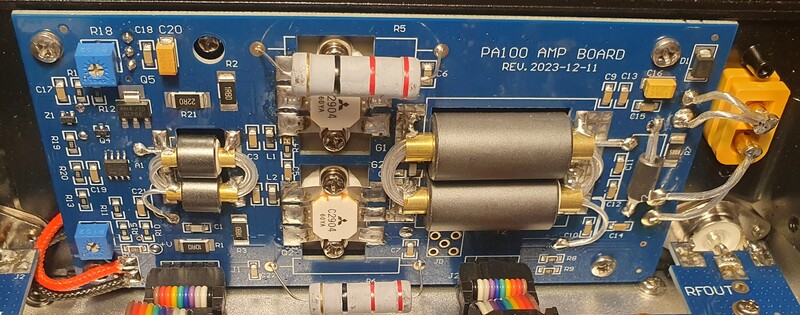
Up against the rear heatsink panel is the RF deck which consists of a pair of Mitsubishi 2SC2904s in a conventional push pull class AB setup, along with bias stabilisation circuitry and impedance matching magnetics.
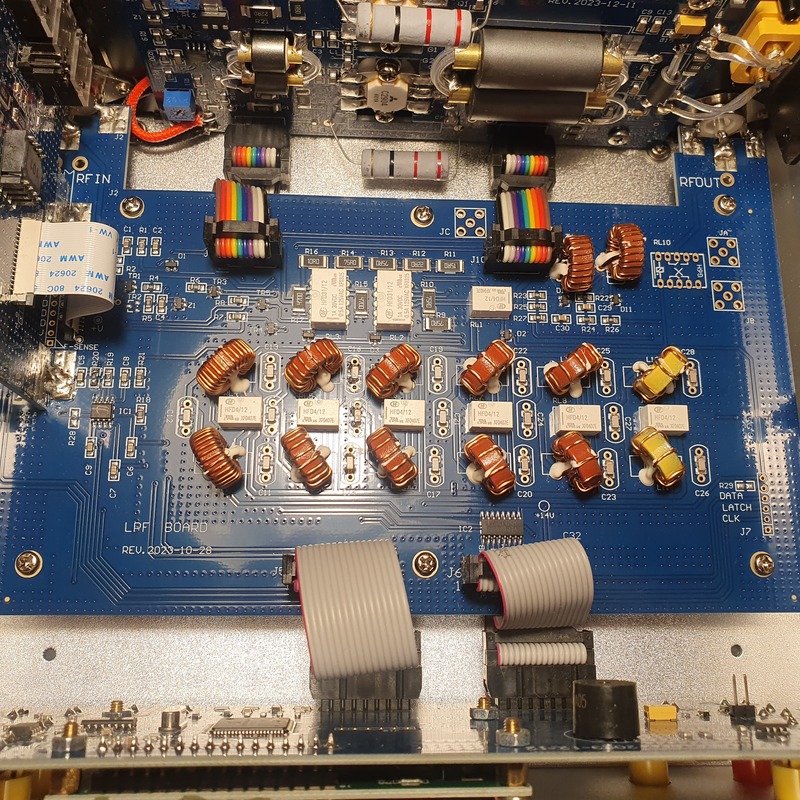
A board on the bottom of the case contains 6 low pass output filter networks along with switching relays for the filters, TX and RX signal path switching and two input attenuators. This also contains a directional coupler for forward and reverse power sensing, some relay drivers and a current sensing chip to detect the final current drain.
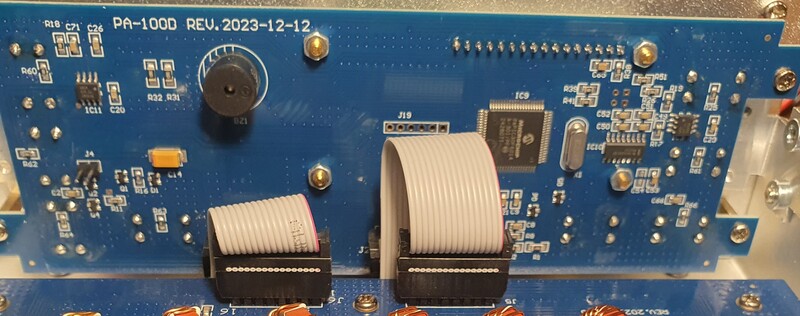
Against the front panel is a control board containing the LCD display, front panel buttons, a dsPIC30F6014 processor, an RS-232 level converter, some fan speed control circuitry and power supply regulators.
There is one further board which houses the three rear panel jack sockets for the control signals and some signal conditioning for the input transmit frequency detection.
The quality of construction looks good, with nothing to raise alarm bells internally.
Conclusions
Few 100W HF amplifiers on the market represent as good value for money as the RS-928, and the sample I received performs well.
The RS-928 is a Chinese clone of Juma's work and this may put off some buyers. The performance of the RS-928 would give me confidence in purchasing the Juma PA-100D from Rowaves too, however. It's likely that the latter will have had better attention to component quality and matching, and calibration during production, possibly giving even better performance, albeit at a higher price.
Out-of the box, in my opinion, the RS-928 would be a great companion to the Hermes Lite, FT-817/817, IC-705 and other QRP rigs when used attended in the shack or in a vehicle. Its size and weight probably don't lend it to portable use a significant distance from a vehicle.
The firmware supplied with the RS-928 is clearly based on an old or stripped-back version of the PA-100D code, doesn't have usable remote control facilities that would allow easy unattended remote operation, and suffers from an irritating issue with the SWR alarm when tuning-up. It is, apparently, possible to flash it with later Juma firmware.
Overall, I am very happy with this amplifier, and would recommend it and the Juma PA-100D to anyone wanting a few more watts out of a QRP HF rig.
I hope you find this helpful. Please feel free to message me on the forum if you have any questions.
73 for now de Kevin G7BCS